We’re blessed in Virginia to reside in the larger context of a Constitutional Republic. Our rights are protected by a representative system whereby the people elect legislators who govern us within the metes and bounds of our constitution. We’re also fortunate for the courts that guard against encroachments on those rights when the legislative or the executive branches strip them away. Indeed, we just witnessed the intervention of the Supreme Court of Virginia in nullifying the recent referendum that would have wrongly reimposed partisan Gerrymandering on Virginia, despite our 2020 amendment requiring non-partisan redistricting.
The Supreme Court of Virginia acted as Chief Justice John Marshall advised in Marbury v. Madison when he wrote that “It is emphatically the province and duty of the judicial department to say what the law is.” Moreover, Virginia Justice D. Arthur Kelsey noted in reversing the redistricting scheme that Marshall’s law professor, George Wythe, emphasized two important duties of the courts. The first is “to declare constitutional boundaries of political power.” The second is exhibiting “the courage to ‘fearlessly’ protect them.” Justice Kelsey and the majority of the court have done both exceedingly well.
They, in a fashion, upended the plans by the Democrat Governor, State Senate, and House of Delegates to defenestrate Virginia’s constitutional provision abolishing partisan redistricting, substituting a new amendment to allow Gerrymandering solely by the General Assembly pursuant to its most partisan political designs. Such was an affront to the rights of Virginians by ignoring the Constitution’s procedural requirement that any amendment must be approved by the General Assembly twice, once before the next general election, and then again by legislators after that election.
The wisdom underlying this procedure was to deliberately slow the amendment process so that the voters would have an opportunity to signal their approval or disapproval of legislative candidates supporting controversial amendments. Indeed, dissatisfaction at the polls over a proposed amendment could result in its failure to pass in the subsequent legislative session following that election.
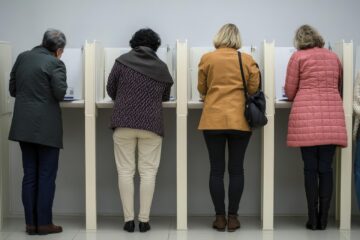
At issue before the court was whether the General Assembly passed the proposed amendment prior to that intervening election. The Republicans protested that it had not, pointing out that voting in the 2025 general election began on 19 September and ended on 4 November, Election Day. Yet the General Assembly’s initial vote for the proposed constitutional amendment to go before the electorate occurred on October 31, after over 1.3 million votes—40 percent of the entire vote—had already been cast in the election cycle. The court agreed, concluding that the election is not simply a date on a calendar, but rather a period of time starting when people begin participating in early voting and concluding on what we call Election Day.
In citing their opposition to Democrat lawyers seeking to ignore that elections begin with the first casting of early votes, the court settled on a precise definition to resolve the issue. “History confirms that ‘election’ includes both ballot casting and ballot receipt.” Indeed, in the 63 prior constitutional amendments adopted since 1971, “The Commonwealth has identified none in which the General Assembly passed a proposed amendment after voting in the general election had already begun.” In essence, the court concluded that “The Commonwealth implicitly concedes that early voting is one of the combined actions of the election when it recognizes that early voting is ‘casting a ballot to be counted on Election Day.’”
In that regard, the court made clear that when citizens cast ballots early, “the durational term ‘election’ and the determinate term ‘Election Day’ fit together perfectly.
In essence, what the ruling Democrat majority advocated—with the clear approval of Governor Abigail Spanberger—amounted to “denying over 1.3 million Virginians their constitutional right to have a voice in the debate over whether their Constitution should be amended—thereby eroding one of the core rights that Article XII, Section 1 was intended to safeguard.”
Their final verdict was resounding. “For these reasons, we hold that the definition of ‘general election’ in Article XII, Section 1 describes the combined actions of voters casting ballots and officers of election receiving those votes and closing the polls on the last day of the election.” It was a conclusion a blind Bartimaeus could have seen before he was miraculously healed.
Despite a resounding defeat in this case, Democrats will now seek an appeal to the U.S. Supreme Court. It is a petulant act of intransigence in the face of sound legal reason. As Justice Kelsey noted, “While the Commonwealth is free by its lights to do the right thing for the right reason, the Rule of Law requires that it be done the right way.” Democrats didn’t, and the court’s decision was a frank and firm critique of calcified legislative minds more interested in attaining power than judiciously and legally employing it.




0 Comments